
Mobile Home Demolition in San Francisco, CA
Is an old mobile home sitting on your lot? We tear it down and haul it away. Our crew serves San Francisco and the Bay Area. We work in mobile home parks and on private land. We also remove the slab and the tie downs when you want a clean lot.
First, we check the home and the site. Next, we handle the permit, the asbestos test and the utility shutoffs. Then we take the home down and clean up. This means that you do not have to run from office to office. We do it for you.
Get Your Free Mobile Home Quote
Single wide, double wide, trailer, or concrete pad—share your Bay Area lot details below for a free site check and fixed quote.
No obligation • Direct local dispatch: (415) 555-0196
Services for Single Wide, Double Wide and Trailer Homes
Every lot is different. A tight park lane needs small machines. A rural parcel needs big ones. A leftover slab needs a hammer. We take down every kind of manufactured home, and we match the crew and the machines to your site. Start with the type of home you have. Then pick the service that fits your lot.
Single Wide Teardown and Removal
A single wide is one long section on one steel chassis. It is the smallest type of home, so it is the fastest to take down. Most single wides come down in one to two days. Our crew strips the metal siding and roof, pulls the walls in with an excavator and loads everything into dump trailers. We also cut up the chassis so it can go to a scrap yard. This means that you get a bare lot at the end of the job.
Double Wide Teardown and Removal
A double wide is two sections joined down the middle. It has two steel chassis, a bigger roof and more weight to haul. Because of this, the job takes more time and more trips to the dump. Most double wides take two to three days. We take the roof off first and then split the home at the seam. Next, we pull each half down in a safe order. This keeps debris away from your fence, your trees and the home next door.
Older Trailers and Damaged Homes
Some homes are in rough shape. The roof may have caved in, or a fire or a storm may have hit it. Others are older trailers with thin walls and old materials inside. These homes can be unsafe to walk through, so we take them down with the machine instead of by hand. We also test for asbestos first. Homes built before about 1980 can have it in the ceiling, the floor tile and the pipe wrap. If a fire caused the damage, our fire damage demolition crew handles fast cleanup.
Mobile Home Park and Community Removal
Parks have tight lanes and close neighbors. Park managers also set strict rules for the lot. Our mobile home park removal service is built for these jobs. We use small tracked machines to protect the pavement. We follow the park’s work hours and send proof of insurance when the manager asks for it. We cap the utilities, take the home down and rake the lot. This means that the space is ready for the next home.
Rural Acreage Manufactured Home Teardown
Land outside the city brings other problems. Roads can be rough, and old utility lines can be hard to find. Our rural acreage demolition service covers these sites. We bring bigger machines and large dump trailers. We also clear sheds, decks, carports and brush near the home. If you plan to build next, we can also level the spot with ADU pad grading. This means that your land is ready for a new house or an ADU.
Mobile Home Tie Downs and Concrete Pad Removal
Taking down the home is only half of the job. Ground anchors and a cracked slab often stay behind. Our tie down and concrete pad removal service takes out both. We dig out the anchors and break up the concrete with a hydraulic breaker. Then we haul the pieces to a recycler. This means that your lot is flat and clear. We also handle standalone foundation slab removal.
What Is Included in Every Job
Each quote covers the same core work. Here is what you get:
- A site visit and a fixed quote
- The demolition permit
- The asbestos test and the utility shutoffs
- The teardown with the right machine for your home
- Hauling of all debris to a dump or recycler
- Scrap metal removal
- Final grading and a magnet sweep for nails
Do you want the slab, the tie downs, a shed or a deck gone too? Tell us on the first call. We will add them to your quote so that you only pay once.
How Our Mobile Home Teardown Process Works
Here is what happens from the first call to the last rake pass.
1. Site visit and quote.
We look at the home, the access and the base under it. Then we send you a fixed quote.
2. Paperwork.
Next, we pull the demolition permit. We also help with the state housing paperwork and the county tax clearance when your home needs them.
3. Asbestos test.
Older homes can hide asbestos in the ceiling, the floor tile and the pipe wrap. We test samples first. If we find asbestos, a licensed abatement crew removes it before we start.
4. Utility shutoffs.
Also, the gas, power, water and sewer lines must be shut off and capped. We set up the PG&E visit and cap the lines so every utility disconnect is complete before work begins.
5. Teardown.
Then our excavator pulls the home down in sections. We sort the wood, metal and trash as we go. We cut up the steel chassis so it can go to a scrap yard.
6. Cleanup.
Last, we haul away the debris. We remove the slab or the tie downs if you want them gone. We grade the lot and sweep it with a magnet to catch nails.
Want to know how long each step takes? Check our mobile home teardown timeline answer below.
Why Choose Us Over Other Mobile Home Removal Companies
You have many choices when you need an old home gone. Some companies only haul junk. Others only run a machine and leave the paperwork to you. We do the whole job from the first call to the last sweep. Here is how that works.
We Handle the Paperwork
Permits slow down many teardowns. We take care of them so that you do not have to. We pull the demolition permit and set up the asbestos test. We also book the utility shutoffs and help with the state housing filing and the county tax clearance. This means that you sign a few forms and we do the rest.
We Use the Right Machines
A mobile home has a steel chassis, and it often sits on concrete. Most junk haulers do not have the tools to cut steel or break a slab. We bring excavators with grapples, hydraulic breakers and cutting torches. We also bring small tracked machines for tight park lanes. The right tool makes the job faster, safer and cleaner.
We Know the Bay Area Rules
Each city and county has its own steps. San Francisco asks for a PG&E disconnect letter and a debris recovery plan before it issues a permit. The air district asks for asbestos testing and advance notice. We work with these offices all the time. This means that we file the right forms in the right order, and your job does not stall.
We Test for Asbestos First
Older homes can hide asbestos in places you cannot see. We test samples before we start. If we find asbestos, a licensed abatement crew removes it first. Then we take the home down. This keeps dust off your lot and away from your neighbors. It also keeps your job legal.
We Recycle What We Can
We sort the metal, wood and concrete as we work. The steel chassis, the copper wire and the aluminum siding go to scrap yards. The concrete goes to a recycler. This helps meet the 65% recycling rule, and the scrap value can lower your bill. If you want to save parts of your home, ask us about selective salvaging and deconstruction options.
We Are Licensed and Insured
We hold CSLB License #103982. We carry liability insurance and workers’ compensation. You can ask to see proof at any time. Park managers and cities often ask for it too, so we keep it ready.
We Give Clear Prices
You get a fixed quote after the site visit. It lists what is in the job and what is not. If we find asbestos or a buried slab, we tell you before we do the extra work. This means that you never get a surprise bill.
We Leave a Clean Lot
When we finish, the ground is graded and raked. We sweep it with a magnet to catch nails and screws. We also check your fence, your driveway and your neighbor’s property.
How We Compare to a Junk Hauler
Demolition Permits and State Paperwork
Taking down a home takes more than a machine. There is paperwork too. Here is what to expect.
Local demolition permit.
California does not have one statewide demolition permit. Your city or county building office issues it. In San Francisco, the Department of Building Inspection (DBI) issues it.
Debris plan.
Inside the city, DBI asks for a PG&E disconnect letter. It also asks for an approved debris recovery plan. This plan must show that at least 65% of the waste will be recycled or reused.
Asbestos notice.
Bay Area air rules call for asbestos testing and advance notice before a demolition. Most jobs need 10 business days of notice. Homes with four or fewer units can use a shorter 72 hour notice for an added fee.
State housing paperwork.
A manufactured home is titled with the California Department of Housing and Community Development (HCD). We help you find the right filing for your home, such as a salvage certificate. We also help with the county tax clearance if it applies.
Each city has its own steps. Contact our crew and we will walk through every permit and state filing in order.
Our Mobile Home Demolition Recent Projects
Take a look at recent jobs our crew completed across the San Francisco Bay Area.
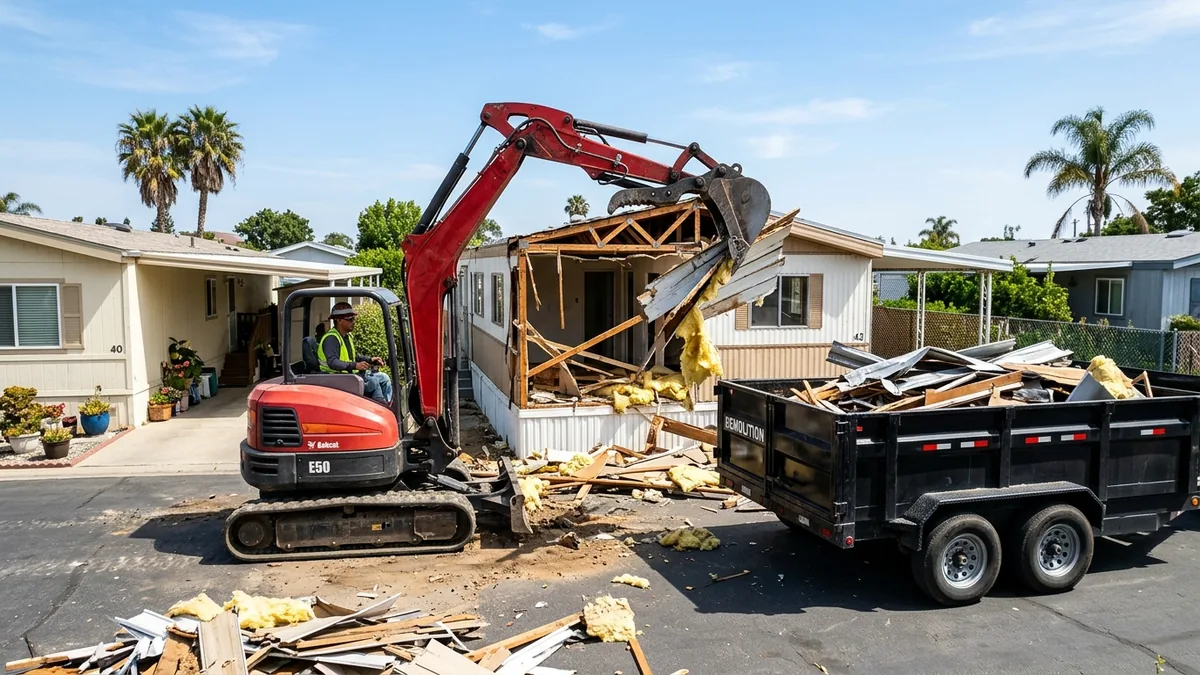
1. Single Wide Teardown in South San Francisco
- Location: South San Francisco, San Mateo County
- Service: Single wide teardown inside a mobile home park
- What was removed: Worn wall framing, insulation, aluminum roof panels, skirting and the steel chassis.
- The outcome: Our crew took the home down in sections with a tracked excavator. We loaded the debris into our dump trailers. We left a clean pad for the park manager.
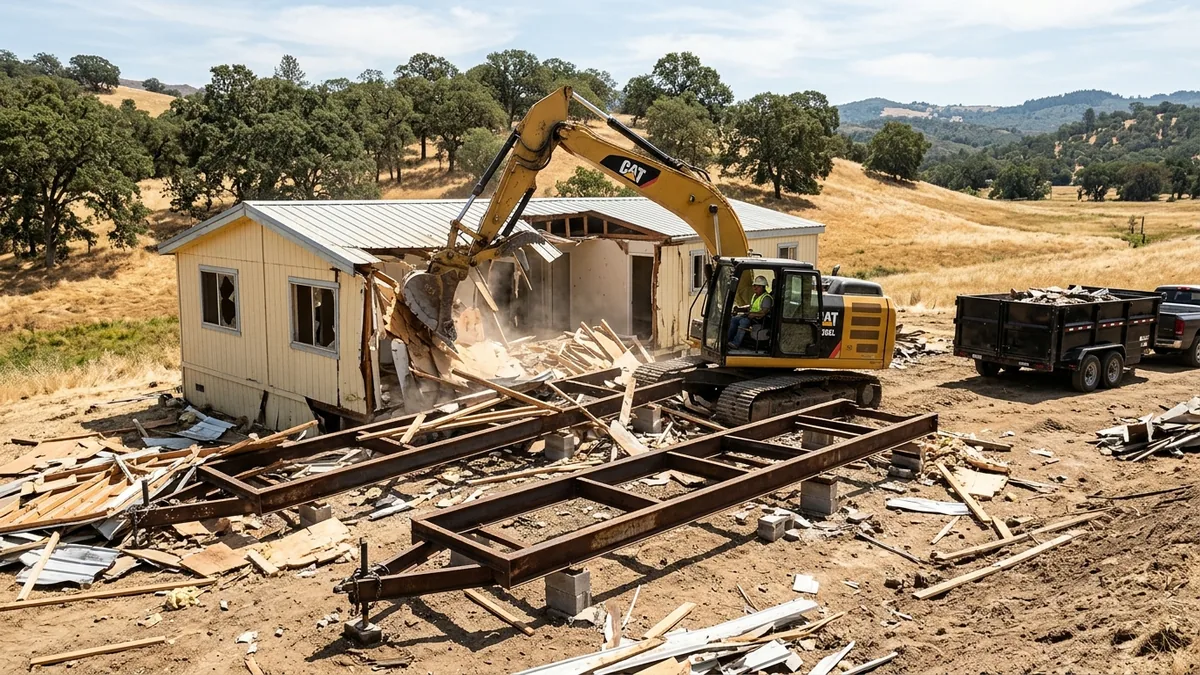
2. Double Wide Demolition on Rural Acreage in Petaluma
- Location: Petaluma, Sonoma County
- Service: Double wide teardown and brush clearing
- What was removed: Wall framing, roof panels, two steel chassis, a rotted deck and two old sheds.
- The outcome: We cleared the whole site in one visit. The owner now has a flat, open parcel ready for a new home.
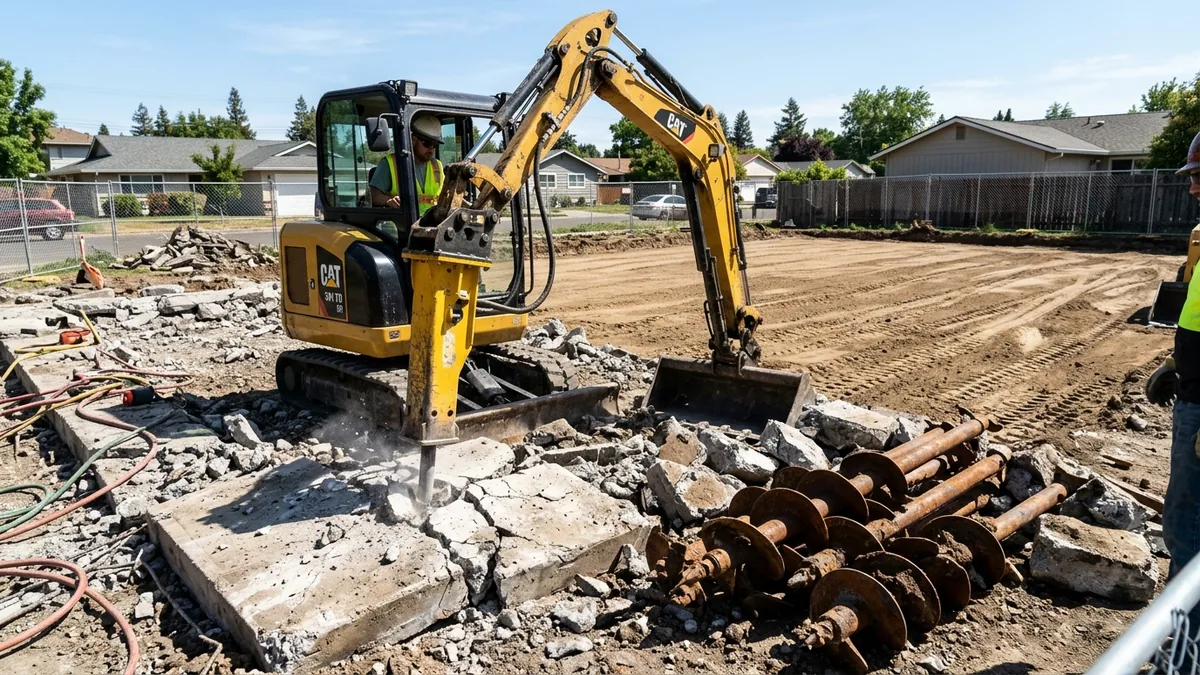
3. Slab and Ground Anchor Removal in Hayward
- Location: Hayward, Alameda County
- Service: Slab breaking and ground anchor removal
- What was removed: Cracked concrete runners, a poured slab and rusted ground anchors.
- The outcome: We broke up the concrete with a hydraulic breaker and dug out each anchor. We hauled the rubble to a recycler and graded the lot.
Questions to Ask Before You Hire Anyone
Use this list with any company, including us:
- Is your contractor license active? What is the number?
- Can you show proof of liability insurance and workers' compensation?
- Does the quote include the permit, the asbestos test and the utility shutoffs?
- Is the slab or the tie downs in the price, or is that extra?
- Where does the debris go?
- Who is on site on the day of the teardown?
A good company answers each question in plain words. If a company cannot, keep looking.
Other Work We Can Do on the Same Lot
Many owners need more than the home gone. Our machines are already on site, so we can clear the rest of the lot in the same visit. This saves you from hiring a second company.
Overgrown lots
Our brush and tree clearing crew cuts back the growth around the home.
Old garages and sheds
We can take down a detached garage on the same trip.
Extra dirt and rock
We load and haul spoil with our dirt and rock hauling service.
A house on the same property
Our residential demolition team takes down stick-built homes.
Local San Francisco Bay Area Neighborhoods We Serve
Our crews provide mobile home demolition, concrete breaking, and site cleanup across San Francisco and the surrounding Bay Area counties:
San Francisco
Mission District, Bayview, Hunters Point, Excelsior, Visitacion Valley, Portola, Bernal Heights, Sunset, Richmond District, Ingleside, Outer Mission, SoMa.
Peninsula and San Mateo County
Daly City, South San Francisco, San Bruno, Pacifica, Millbrae, Burlingame, San Mateo, San Carlos, Redwood City, Half Moon Bay, Menlo Park, East Palo Alto.
South Bay and Santa Clara County
San Jose, Santa Clara, Sunnyvale, Mountain View, Palo Alto, Milpitas, Campbell, Los Gatos, Morgan Hill, Gilroy.
East Bay (Alameda and Contra Costa Counties)
Oakland, Berkeley, Alameda, San Leandro, Hayward, Fremont, Union City, Livermore, Pleasanton, Richmond, Concord, Walnut Creek, Antioch, Pittsburg.
North Bay (Marin, Sonoma, Solano and Napa Counties)
San Rafael, Novato, Mill Valley, Petaluma, Santa Rosa, Napa, Vallejo, Fairfield, Vacaville.
Do not see your town? Send us your address or call us.
Questions About Taking Down a Mobile Home
How long does a teardown take?
Most single wide homes come down in one to two days. Double wides often take two to three days. Permits and utility shutoffs take longer, often a few weeks.
Do you remove the concrete pad and the tie downs?
Yes. We can add them to your quote or remove them later. Read about our ground anchor and slab removal process above.
Can you work inside a mobile home park?
Yes. We follow the park rules for work hours, insurance and lot cleanup. We also protect your neighbors’ homes. See how we handle removal inside a community park above.
What happens to the metal and the other debris?
We cut the chassis and send it to a scrap yard. Wood, concrete and other materials go to recyclers when we can.
Can you take down a trailer home?
Yes. We take down trailer homes, single wides and double wides. For a small travel trailer, call us first.
Do I need to cancel the title first?
Not always. It depends on your home. Call us and we will tell you which housing and tax steps apply.
Is asbestos a problem in older homes?
Homes built before about 1980 can have asbestos. We test first. If we find it, a licensed abatement crew removes it before we begin.
Ready to Clear Your Lot?
Call us or send the form. We will visit the site, explain each step and give you a fixed quote.
- Direct Dispatch: (415) 555-0196
- CSLB License #103982 (C-21 & Class A)
- SF DBI Permits, BAAQMD J-Numbers & 75%+ Recycling
Request Your Free Written Estimate
Share your San Francisco or Bay Area property details below and we will schedule your free on-site walk.